
You can buy a humanoid robot in Dubai today. It costs about what a used Land Cruiser costs, it walks better than you expect, and it will not clean your house, carry your shopping or serve your guests. This page is the long version of that sentence, with the specifications, the prices in dirhams, and the fine print that the sellers leave out.
The four conditions. For a humanoid to be worth buying for a home it needs a human shape, a published price, availability to a private buyer, and the ability to do a real household task without supervision. As of September 2026, no robot in the world meets all four at once. Everything below explains which condition each model fails, and why.
Unitree G1: the one from all the videos
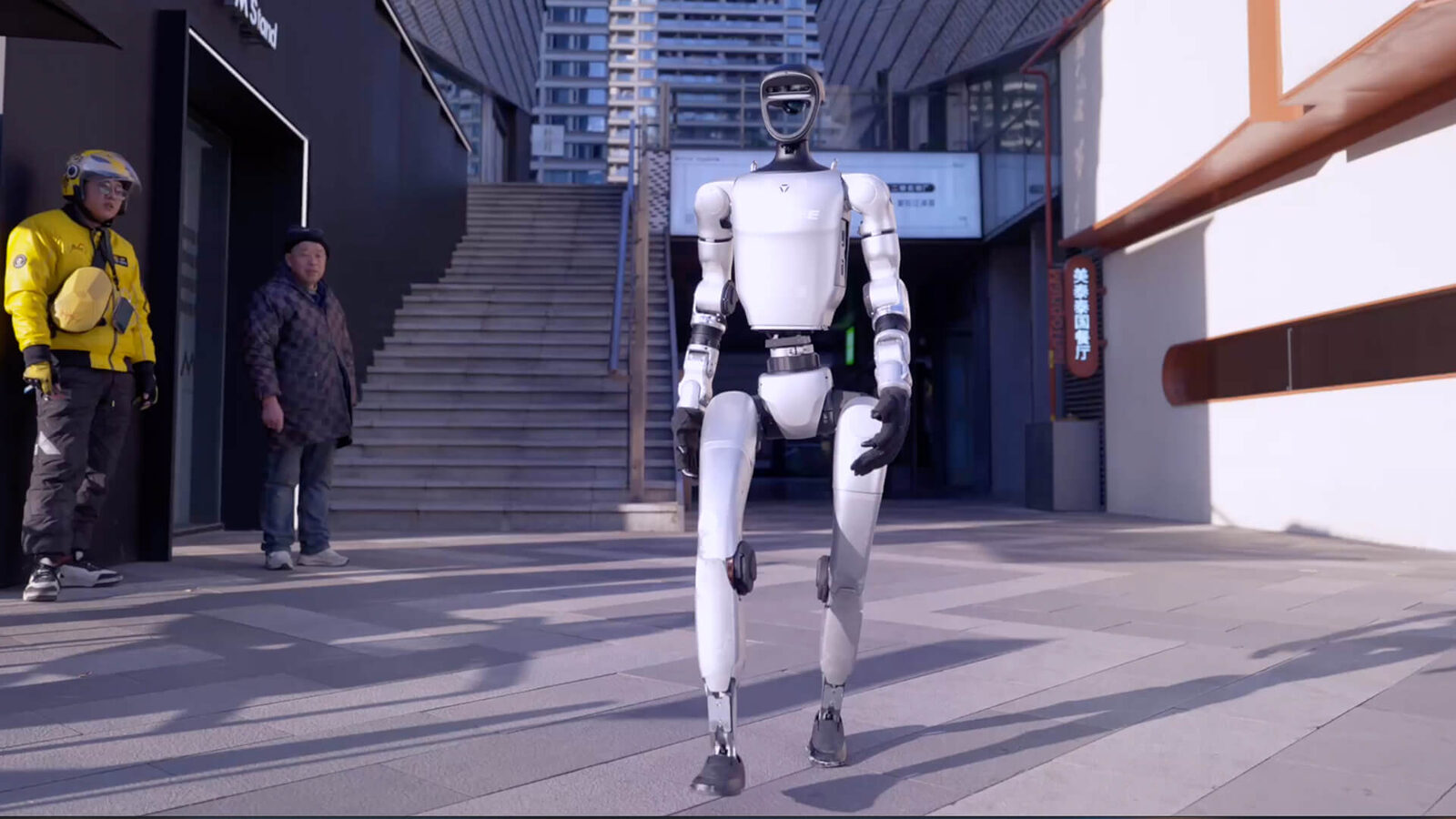
This is the machine that made humanoids feel imminent. It is remarkable engineering at a price that broke the category open: Unitree lists it from 13,500 US dollars, when comparable machines cost six figures. In Dubai it has been resold at around 92,000 AED, close to double the factory price, which tells you how thin the local supply chain still is.
- Price from
- 13,500 USD at the factory, roughly 49,500 AED. Resold locally at around 92,000 AED.
- Height standing
- 1,320 mm, about chest height on an adult
- Footprint
- 450 mm wide, 200 mm thick
- Folded
- 690 x 450 x 300 mm. It folds down and fits in a car boot
- Weight
- About 35 kg with battery
- Degrees of freedom
- 23 standard, 23 to 43 on the EDU version
- Per leg
- 6
- Per arm
- 5
- Hands
- None on the base model. The EDU can take the Dex3-1 three fingered hand: 7 degrees of freedom per hand, optional tactile sensor arrays
- Waist
- 1 degree of freedom, 2 more optional on EDU
- Warranty
- 8 months on the civilian version, 18 on the research version
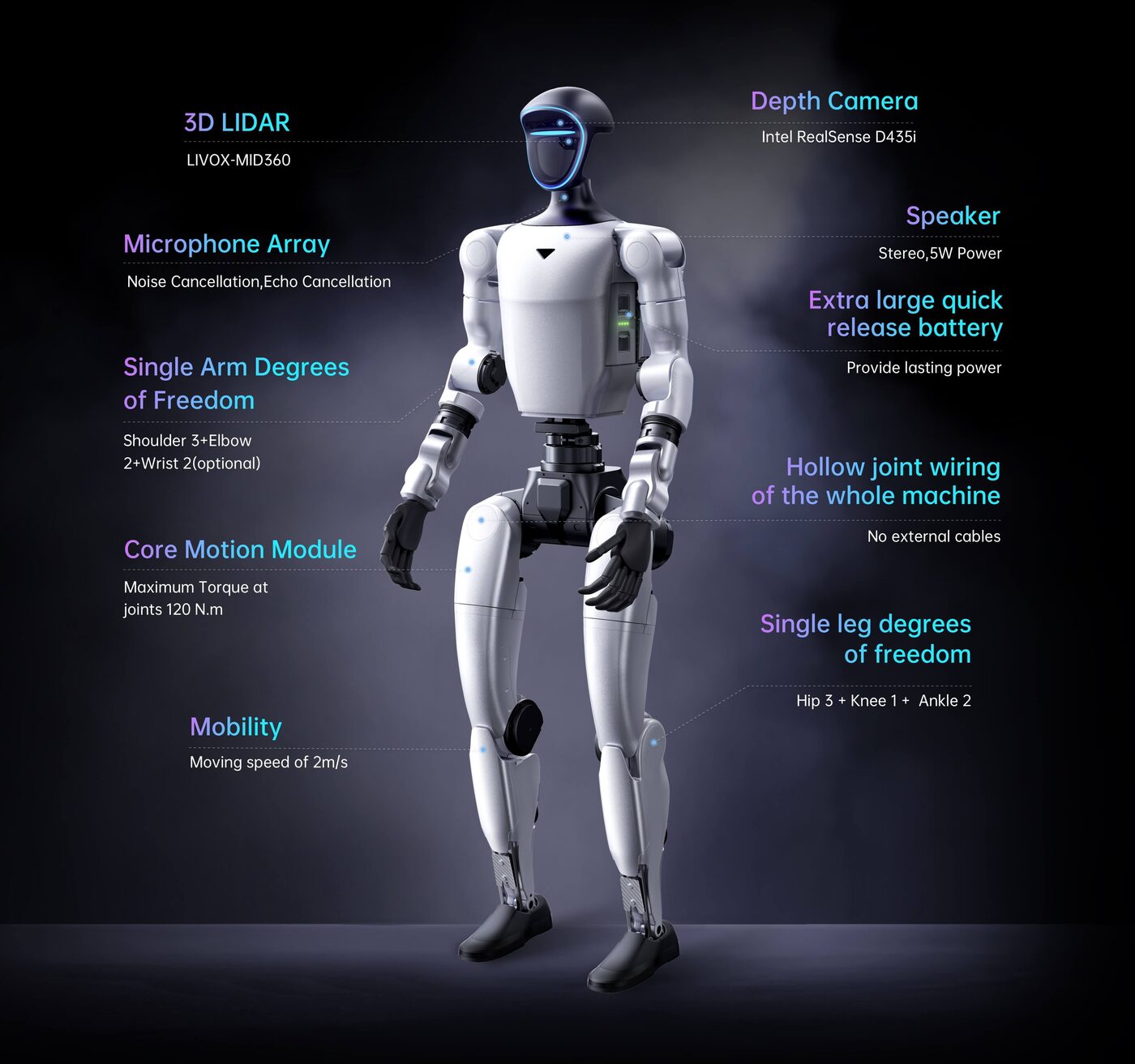
Read that list again and the problem announces itself. The base G1 has no hands. It has arms with five degrees of freedom each and nothing on the end of them. The three fingered Dex3-1 is an option on the more expensive EDU version, and three fingers with seven degrees of freedom, impressive as that is, is nothing like a human hand with its twenty seven.
A machine without hands cannot pick up a sock, wring out a cloth, load a dishwasher or carry a tray of drinks across a marble floor without wearing them. It can walk beautifully. It can dance. It can recover from a shove. Watch what Unitree itself chooses to show you:
Unitree's own showcase: athletics, balance, recovery. Not one household task appears in it, and that is not an oversight.
Unitree is not hiding any of this. Its own product page carries a warning that resellers quietly omit: the humanoid robot industry is in the early stages of exploration, and individual users are strongly advised to understand the limitations thoroughly before buying. A manufacturer that gives its civilian robot eight months of warranty is telling you, in the only language a legal department speaks, how mature it considers the product to be.
Buy a G1 because you want to develop on it, or because you want the most impressive object in the room. Do not buy one because you want help with the house.
Who the G1 is actually for
- Universities and research groups. The market it was built for, and it serves it superbly.
- Software teams who need a walking platform without spending 150,000 dollars.
- Events, showrooms and marketing. In Dubai this is the honest commercial use today. A humanoid walking through a launch earns its cost back in attention.
- Collectors who want the object and know exactly what it is.
1X NEO: the right idea, with a problem you need to hear
NEO is the only humanoid designed from the start for housework rather than factories or research. It is 20,000 US dollars outright or 499 dollars a month, with a 200 dollar reservation deposit, and pre-orders opened in October 2025. Deliveries are stated to begin in the United States during 2026, with no announced international shipping and nothing for the UAE.
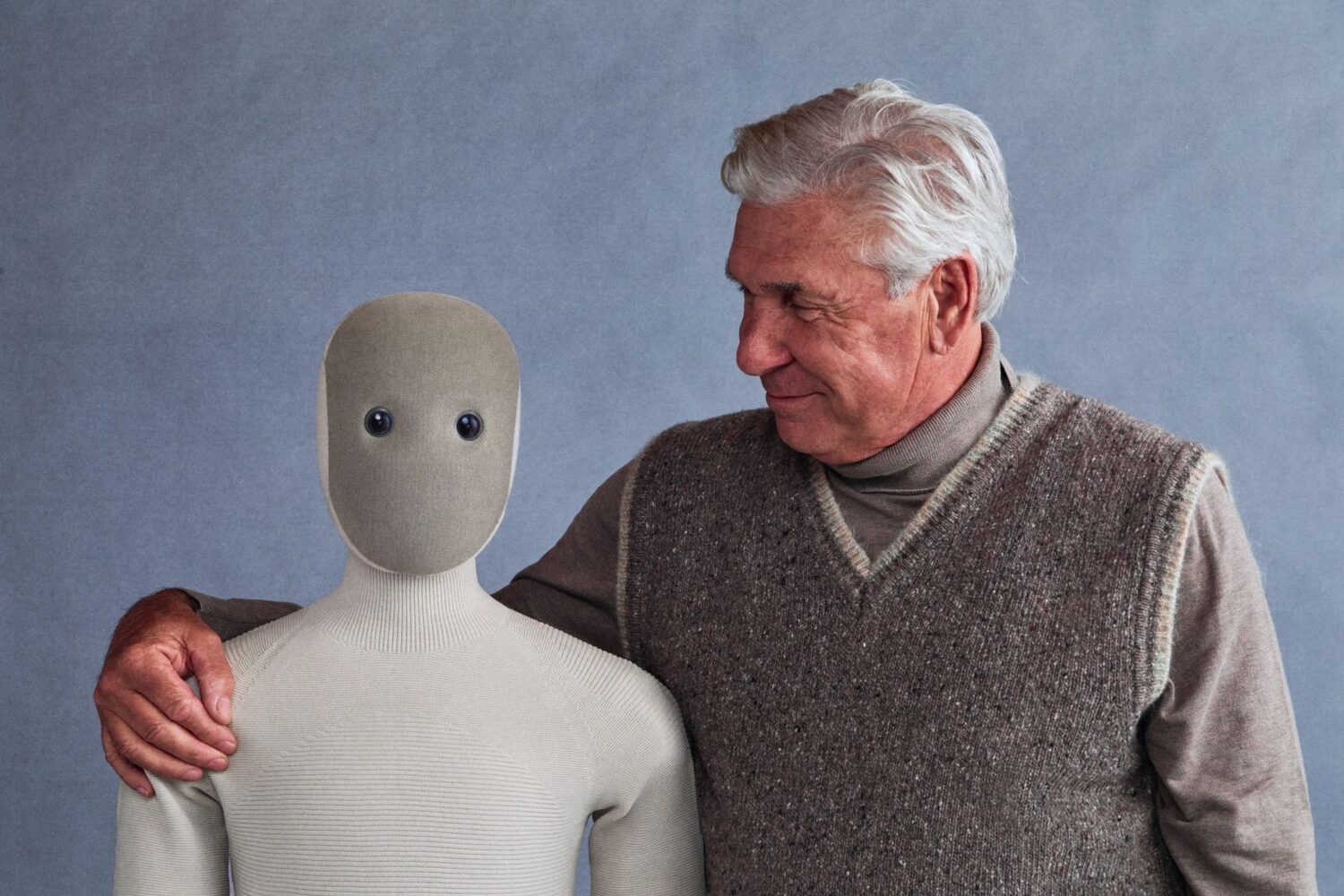
That alone makes it a "not yet" for a buyer here. But there is a second thing, and it is why I would not sell one even once it reaches this region.
NEO is substantially teleoperated. 1X states on its own product page that during early access, for complex tasks NEO does not know, an expert from 1X can remotely supervise its actions at scheduled times. A company spokesperson confirmed to TechCrunch that customers decide when a 1X employee may view the robot's surroundings, whether for auditing or teleoperation.
Read that in the context of a home. A person employed by a company in another country can look through the robot's cameras inside your house, and it happens at the moment the robot meets something it cannot handle, which is the moment you most wanted it there. 1X has never published what percentage of tasks are autonomous, and the reporting consistently points to teleoperation being structural to how the system learns rather than a rare exception.
In the Gulf this is not a technical footnote. The most persuasive reason to want a domestic robot here is privacy: not having a stranger inside the family home. A robot with a remote human operator inverts that argument completely.
In December 2025, 1X redirected its deployment towards factories and warehouses, with plans for up to 10,000 units through 2030. The reporting read that as an acknowledgement that domestic humanoids remain years away on cost, safety and privacy. I agree, and I would rather say so now than sell you a 20,000 dollar disappointment.
This is 1X presenting the robot themselves. It is worth watching with the teleoperation question in mind, and asking at each task whether you are being shown autonomy or a demonstration:
Richtech ADAM: the one that genuinely works, and is not for your house
If you want to see a humanoid form doing real paid work today, this is it. ADAM is a torso with two arms on a fixed base that makes and serves coffee and cocktails, with more than 450 units deployed, including at NVIDIA's headquarters and in Walmart stores. Its sibling Titan works in a Mercedes-Benz dealership in Texas.
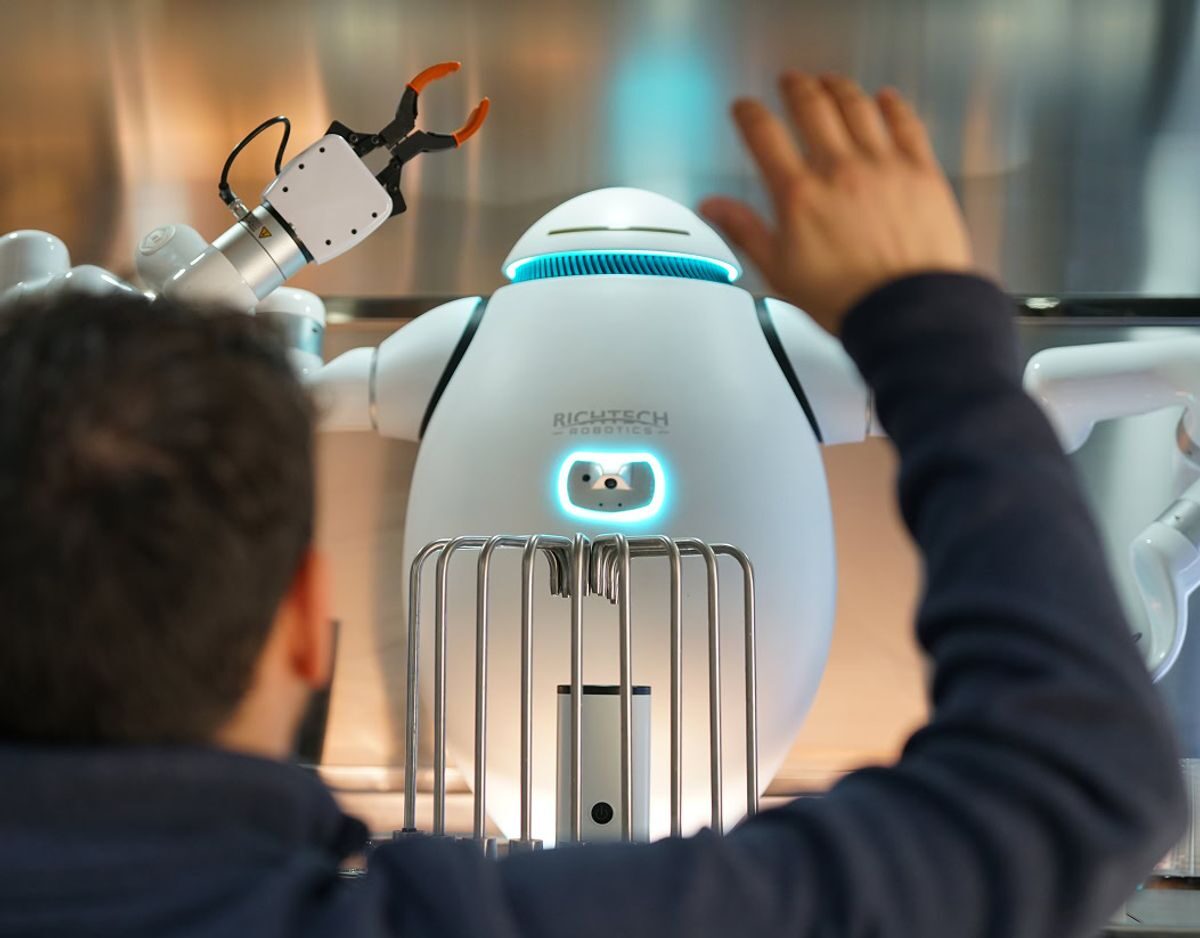
Four hundred and fifty units is not a pilot programme. It is also, for perspective, roughly one hundred and twenty times fewer than the tray-on-wheels robots in the service category, which tells you exactly how much harder arms are than wheels.
The catch here: no published price, no confirmed UAE distribution, and it is commercial equipment quoted per venue rather than a consumer product. If you run a hotel bar or a showroom in Dubai and want the most functional humanoid form on the market, that is a procurement conversation, not an online order, and it is one I am happy to open on your behalf.
Tesla Optimus and Figure: not purchasable
Both appear in every article about humanoids and neither can be bought. Figure is industrial only, with a partnership at BMW. Tesla announced a price of around 30,000 dollars at an event in October 2024, which was never a catalogue price, and was still installing production lines in April 2026. Zero units sold to private customers by either company.
They are listed here because you will meet them in your research, and a shop that only tells you about what it sells is not much use to you.
The wheeled humanoids: the smart idea that is not on sale
A torso with two arms on a wheeled base is, on paper, the right answer for a home. Hands where you need them, no falling over, a battery that lasts a working day instead of two hours, and a lower price because legs are the most expensive and least reliable part of a humanoid. In a Dubai apartment, flat and marble floored throughout, wheels beat legs comfortably.
Astribot's S1 has the most impressive manipulation videos in the industry. Galbot works in retail in China. AgiBot manufactures its A2-W in real volume. Not one of the three publishes a price, a delivery date, or independent verification that those videos are autonomous rather than remotely driven. AgiBot's confirmed production goes to industrial logistics, not homes.
This is the category I expect to break first, and the one this shop watches hardest.
Will any of them climb the stairs in my villa?
The most common question I get, because the typical villa here has two floors, steps down to the garden and the pool, sliding door thresholds and rugs. The answer is measured rather than guessed, and it disappoints everyone equally.
- No purchasable biped has an independently verified demonstration of climbing a real domestic staircase, unaided, unsupervised and without a harness. That covers the Unitree G1, H1 and H2, Booster T1, EngineAI, Fourier, Agility Digit and 1X NEO. A manufacturer video in a prepared environment is not the same as a machine that handles your staircase at seven in the morning with a rug at the bottom of it.
- Wheeled home robots are nowhere near. The most capable domestic robot on the market clears an obstacle of about 4 cm, and its own datasheet says that figure covers door thresholds and furniture legs. A standard residential step is 15 to 22 cm. That is not a gap you close with a firmware update.
So for a two storey villa the honest configuration today is one machine per floor, whatever shape it takes. If you are buying, that means two units rather than one, and you should hear it before the purchase rather than after.
What I would tell you if you called me
Three different conversations, depending on what you actually want.
- You want a job done. Then you do not want a humanoid. The pool, the floors and the windows all have machines that solve them completely today, cost between 4,000 and 9,000 dirhams, and run unsupervised. Start with pool robots or cleaning robots.
- You want the object. Then a G1 is a magnificent purchase, as long as you know it is a walking research platform with an eight month warranty and not an appliance. I will get you one and I will not pretend it does anything it does not.
- You want a robot serving guests at your event. That exists and it works. It is a tray on wheels, or, if the budget stretches and the theatre matters, an ADAM behind the bar.
And if what you want is the machine that folds the laundry and mops the floor while you are at work, it does not exist yet, from anyone, at any price. Leave your email on the home page and you will hear from me once, on the day that stops being true.
Sources
- Unitree Robotics, G1 product page and parameter sheet: dimensions, degrees of freedom, Dex3-1 hand specification, price from 13,500 USD and the early stage warning. unitree.com/g1
- Unitree Robotics official YouTube channel, "Unitree G1 has mastered more quirky skills". 1X official channel, "NEO The Home Robot, Order Today".
- 1X Technologies, NEO product and order pages: 20,000 USD or 499 USD monthly, 200 USD reservation, US deliveries from 2026, and the statement on remote expert supervision.
- TechCrunch, February 2025, on 1X confirming employees can view NEO's surroundings for auditing or teleoperation; and December 2025, on the redeployment towards factories and warehouses.
- Richtech Robotics, ADAM and Titan deployment figures including NVIDIA headquarters and Walmart.
- Roborock Saros Z70 datasheet for the 4 cm obstacle figure. Residential step height of 15 to 22 cm from standard building regulations.